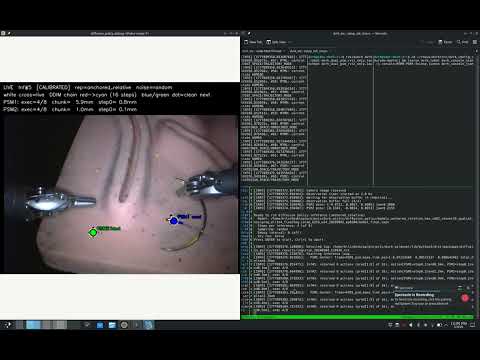
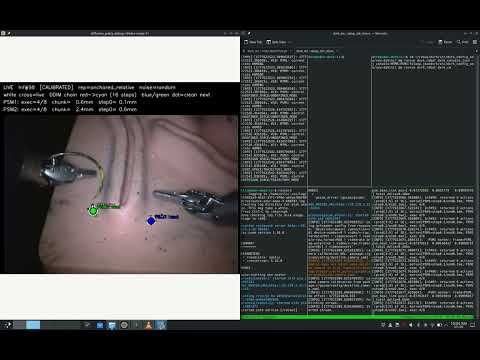
I built and integrated the complete learning pipeline for a bimanual suturing
task on the physical da Vinci Research Kit: robot and camera acquisition,
synchronized demonstrations, dataset conversion, policy architecture,
training, ROS 1 deployment, closed-loop execution, diagnostics, and
real-robot evaluation.
Starting Point
Diffusion Policy
I first came across Diffusion Policy while watching LeRobot project
videos. From there, I followed the references to Cheng Chi's original
work and studied related robot-learning research from Toyota Research
Institute in parallel. That was how I learned the action-diffusion
idea before adapting it to the SDU dVRK setup.
The robot interface was grounded in Johns Hopkins University's open
da Vinci Research Kit software. I built the project-specific recording,
policy, control, and evaluation layers around the physical SDU setup.
The local starting point was an SDU study of uncertainty-aware diffusion
policies and control-barrier safety in simulation. My work addressed the
missing physical pipeline and the train-to-robot gap on the real dVRK.
I adapted feature-decoding ideas and utilities from LeWorldModel, whose
authors include Yann LeCun, then integrated them with my own physical
pose probes, modality attribution, and needle-localization tests.
Integrated training, checkpoints, normalization, and EMA evaluation.
Designed ResNet34 and DINOv2 controlled comparisons.
Adapted LeWorldModel's decoder feature-inversion (Yann LeCun et al.) into a representation-diagnostics suite: decoder reconstructions, tool-pose and modality probes, and needle patch-similarity.
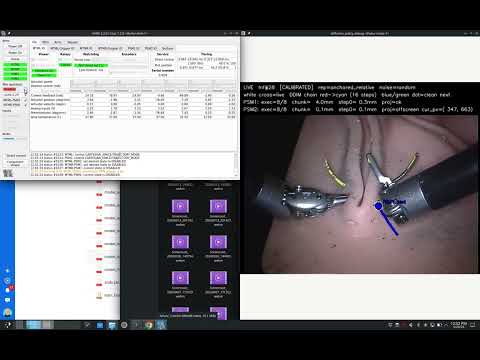
Built offline debug videos and closed-loop overlay tooling.
Integrated ROS 1 inference and evaluated physical closed-loop trials.
What Went Wrong with ResNet
My first policies used the full proprioceptive state together with the
endoscope image. At the beginning I treated the failure as a data or control
representation problem. I rebuilt the pipeline around absolute Cartesian
targets, step-relative motion, and finally anchored-relative targets. I also
changed the rotation representation to rot6d, reworked normalization, and
checked that the dataset labels and the ROS execution path decoded the same
20D command for PSM1 and PSM2.
Those changes fixed real implementation problems, but not the main behavior.
If I moved the needle or raised the suturing pad, the ResNet policy still
tended to replay a grasp associated with the current arm pose. By then it was
clear to me that collecting more of the same demonstrations would not explain
the failure. I first needed to know what the image encoder was actually
preserving.
Inspired by the state-input dropout used in
NVIDIA Isaac GR00T,
I trained ResNet policies while randomly or completely removing the robot
state. The physical results became much worse instead of recovering from the
image. That was an important clue: removing the shortcut did not help if the
visual features still failed to represent the needle.
Looking Inside the Encoder
To inspect the encoder directly, I started from the decoder feature-inversion
approach in LeWorldModel, developed by Yann LeCun and collaborators, and
adapted it to the dVRK checkpoints. I then expanded it into a diagnostic
pipeline with decoder reconstructions, linear and MLP tool-pose probes,
image-versus-state counterfactual ablations, and a patch-similarity test that
queried the thin suturing needle across different frames.
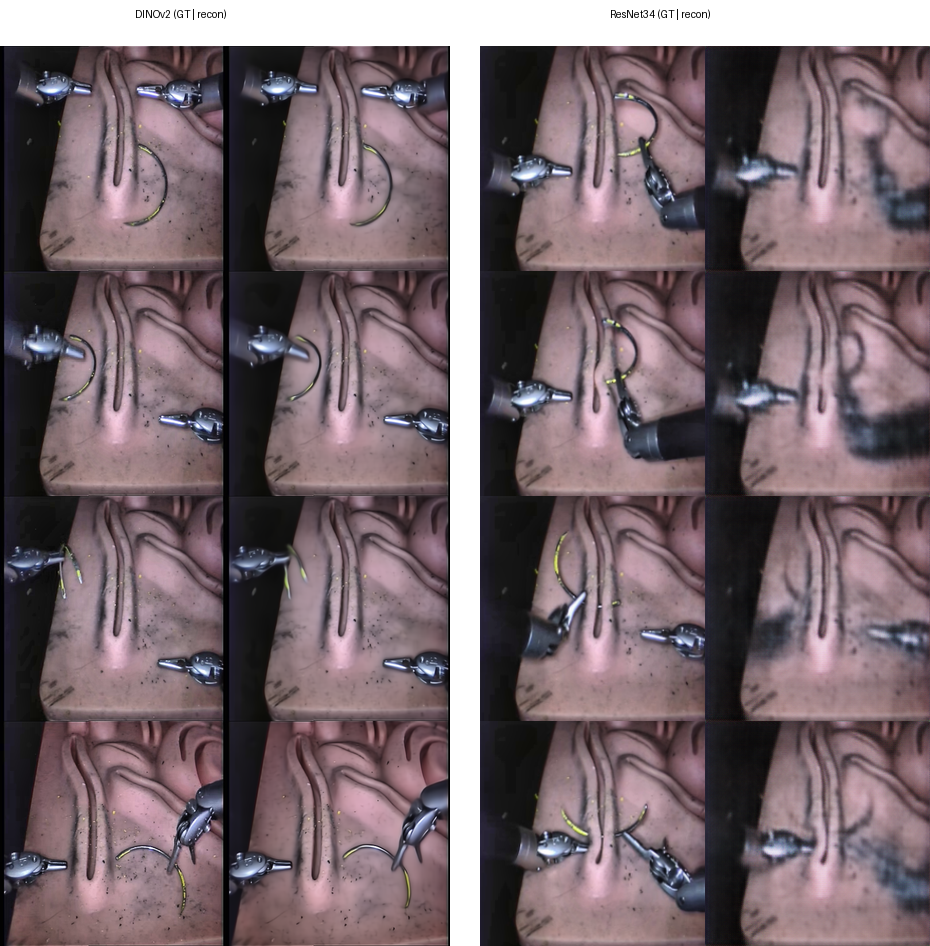
The decoder was the first useful visualization. ResNet retained enough of the
broad scene and robot geometry to support low offline loss, but its
reconstruction blurred away the thin needle. The DINOv2 reconstruction kept
both the needle and the suture much more clearly. A decoder image alone is not
proof, so I used the other probes to check the same conclusion from different
directions.
Decoder feature inversion from my report. DINOv2 preserves the needle and
suture, while the ResNet34 reconstruction loses the fine structure.
Moving to DINOv2
After the ResNet diagnostics, I replaced the visual front-end with a
fine-tuned DINOv2 ViT-S/14. I kept the dataset, anchored-relative action
representation, diffusion model, and physical deployment path fixed so that
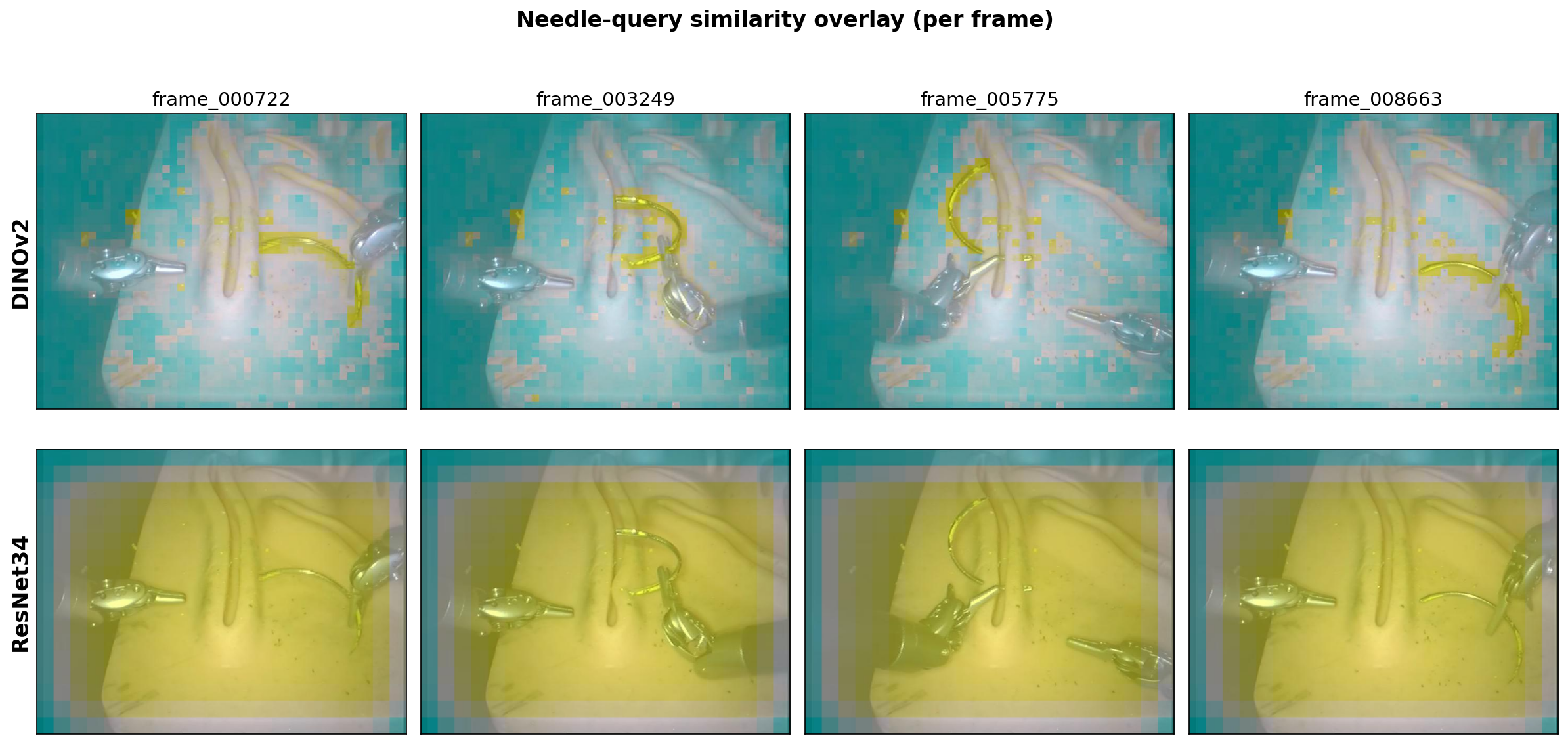
the encoder was the main change. The DINO patch features followed the needle
across frames, whereas the ResNet similarity remained spread over the tissue
and tool bodies.
Needle-query similarity across four frames. DINOv2 remains selective around
the moving needle; ResNet34 does not isolate it.
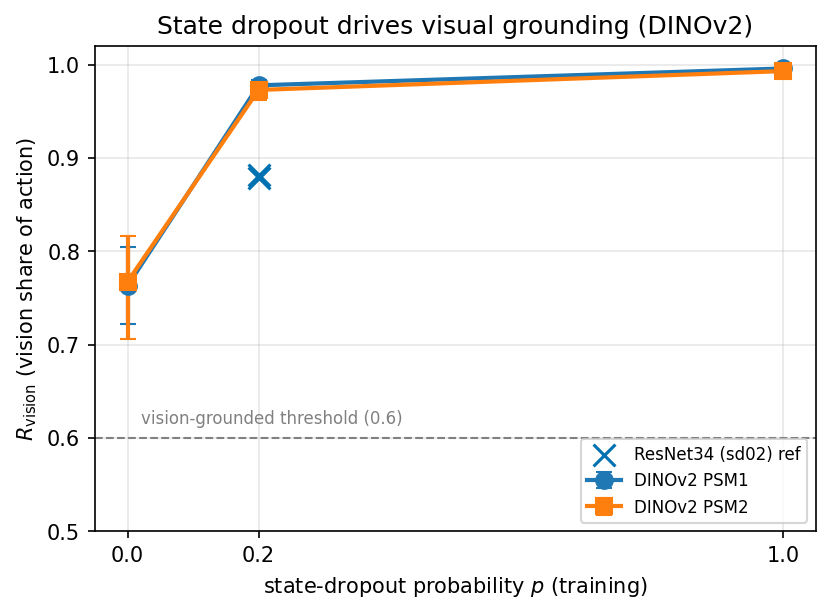
DINOv2 without dropout still used some robot state, so I trained a controlled
sweep with state-dropout probabilities 0, 0.2, and 1.0. The measured vision
share rose from 0.76 to 0.975 and then 0.995. In the final state-free run, the
policy had to form its action from the endoscope images and no longer showed
the same state-linked failure in the tested physical trials.
The DINOv2 state-dropout sweep from the report. Increasing dropout forced
the deployed policy to rely on the visual observation instead of the
proprioceptive shortcut.
The encoder comparison is documented as an individual project report. The
physical observations are qualitative, and the report states the remaining
resolution and probe-sample confounds explicitly.